
Pascal Was Wrong: There (Probably) Is No God-Shaped Hole
And other stuff I've learned from studying the Nones

The renowned seventeenth century mathematician and theologian, Blaise Pascal, believed that all people seek happiness, but he bemoaned the ways that people try to find it in temporal things. “These are all inadequate,” he wrote, “because the infinite abyss can only be filled by an infinite and immutable object, that is to say, only by God Himself.”
Over the centuries, his quote has been popularized to the phrase: a “God-shaped hole,” which supposedly resides inside each of us. Pascal’s idea is so compelling that it’s spawned innumerable sermons and even a couple Christian rock songs.
But recent trends have put Pascal’s thesis to the test. Today, the biggest story about the American religious landscape is the dramatic rise of the “Nones,” Americans who report that their religious affiliation is atheist, agnostic, or they claim no faith in particular. The Nones are currently at an all-time high of about 30 percent, and among Generation Z, that figure is likely around 45 percent.
In other words, 100 million Americans have no religious affiliation, which is unprecedented in the history of the U.S. Yet, it’s striking in how little we really know about this huge number of people. For the last several decades social science has been content to categorize all these non-religious Americans into a single, amorphous social group. However, that is beginning to change.
Ryan Burge and I conducted the largest-ever survey of American Nones in late 2024, funded by a grant from the John Templeton Foundation. We discovered that many Americans don’t miss religion. Or God. Using an artificial intelligence algorithm and a sample of over 12,000 non-religious Americans, we created a new typology of the nones that challenges the assumptions of Pascal (and many preachers) that every human being has a deep yearning for God.
For any of you quant nerds, here are the nuts and bolts of our survey:
A random sample of 15,296 American adults
Conducted using the Qualtrics Survey Platform
12,014 Non-Religious Americans (Atheist, Agnostic, Nothing in Particular)
3,282 Religious Americans (Any Faith Group)
Data collected from April 22, 2024 through May 5, 2024
There were data validation checks that removed low-quality respondents
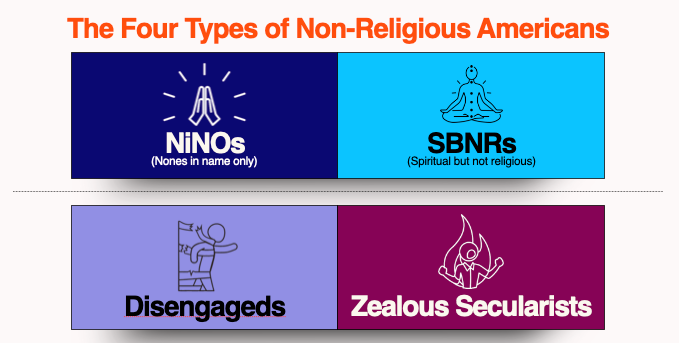
We used a method called K-Means Clustering, in which our machine learning categorized and clusters respondents into groups. The computer is agnostic about the respondents’ answers, since it only sees 1s and 0s, and it came up with these four categories of Nones:
If you want to take a deeper dive into each, Ryan has a series of posts that we co-authored:
Since we’ve already done an in-depth analysis there (plus more posts, every other Saturday, further explicating what we’ve learned, so you should subscribe!), in this space I’m going to give some of my more significant impressions from the data.
The NiNOs Surprised Me
It turns out that about 20 million Nones look a lot like religious Americans, so much so that we called them Nones in Name Only. Over half of them pray at least once per day. Just under half of them “believe in God without a doubt.”
Half of them also trust religion “not at all,” which gives an insight into why they are, in fact, Nones. Nevertheless, in their behaviors and their beliefs, the look pretty similar to Americans who do affiliate with organized religion. They’re not the angry exvangelicals that we often think of.
These are the Nones that religious leaders should be wooing. Of the 100 million American Nones, one-fifth of them look pretty religious. They may not trust religion, but they don’t hate religion (others do; see below). There’s really no reason to woo people who think that religion is bad for the world, but there is some hope that the NiNOs could darken the doors of a church.
There Is No GenZ Revival
The percentage of Nones in America has plateaued at about 30 percent. (Among younger generations (Millennials and GenZ) it’s about 45 percent. And there is at least anecdotal evidence that some Americans in their twenties have at least a passing interest in religion. However, this is anecdotal. In fact, all talk of the supposed GenZ revival is anecdotal. If you want anecdotal evidence, just ask anyone my age (GenX), “How many of your young adult children go to church?” If you ask me that question, it’s one out of three. In other words, they are not replacing me in the pews.
And they’re definitely not replacing the Baby Boomers. That massive and largely religious generation is dying, and there is no data to suggest that GenZers and Alphas are going to replace them one-for-one in the pews.
The SBNRs Are Not Really Spiritual
“Spiritual but not religious” has become a popular phrase in American life, maybe even cliché. They’re a large group — 36 percent of Nones — who claim that title. But when we drilled down into their actual habits and behaviors, it became clear that they are only aspirationally spiritual.
For instance, when we asked them if they’d replaced traditional religious practices with alternative spiritual practices (yoga, Tarot cards, crystals, meditation), the vast majority of them have not. They may consider themselves spiritual, but their actions don’t back that up.
So when someone says to you, “I’m spiritual but not religious,” you have my permission to look at them with skepticism.
The Dones Are Truly Done with Religion
Another large group — 33 million Americans — we classify as the Dones, or the Disengaged. Ninety-nine percent of them report praying “seldom or never.” Same for how often they attend a religious service. They’re not going to get married or buried in a church. They’re not going to let their kids go to Young Life camp.
And they don’t have a God-shaped hole. They don’t long for religion, and they don’t miss it. You might say they’re filling that hole with other things (travelling soccer teams, mushrooms, Crossfit), but that doesn’t show up in the data. Their mental health and well-being indicators are a couple points lower than the Nones who look more religious, but it’s not a massive chasm. They aren’t religious or spiritual, and they’re just fine, thank you very much.
There’s a lot more coming out of our research. We will make the entire dataset available to scholars next spring. In the meantime, Ryan and I are teaching a class with Tripp Fuller of Homebrewed Christianity next month. Join his email list to be informed about the class, or check back here.
As always, thanks for reading.
This is super fascinating, Tony. Thanks for posting this. I'm really looking forward to learning more. Will definitely have to take that HBC class! I'm especially interested in your data on Gen Z and how it is counter to a popular narrative (at least in some of my other circles) of a Gen Z revival. As for me and my household, I'm 0-2 on getting my young adult children in church. (Other than Xmas and Father's Day, when I make them go.)
Does any of your research deal with class issues? e.g. Does income level play any role in people being/becoming a None? Are these mostly folks whose basic needs are never in doubt?